
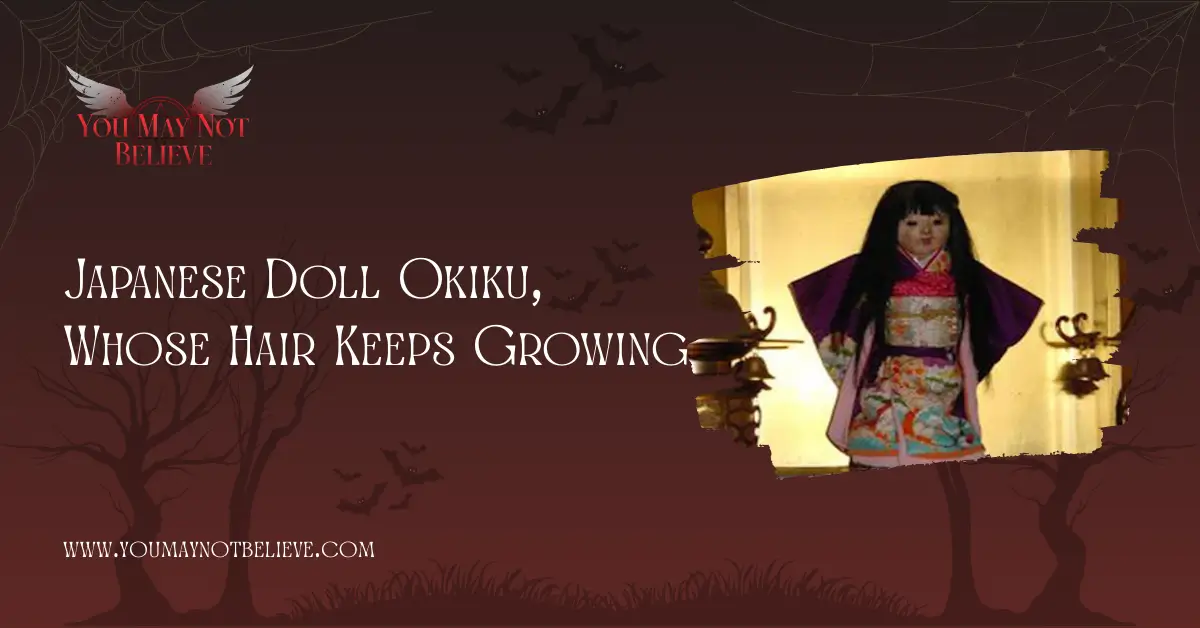
In a peaceful Buddhist temple in northern Japan, one of the world’s most intriguing things can be found: a child’s doll whose hair grows decade after decade, with no scientific explanation. The Okiku doll, presently held in Mannenji Temple in Iwamizawa, Hokkaido, has attracted both believers and sceptics since the 1930s, when her hair began to grow longer than its original bob cut.
What began as a treasured gift for a young girl named Okiku in 1918 has evolved into a haunted doll known in Japan as a vehicle for a child’s restless soul. Scientists have analysed the hair several times, verifying that it is real human hair from a child, but no one understands how an inanimate object can continue to produce hair at a rate of about one centimetre each year.
This is the tragic, disturbing, and eternally fascinating story of Okiku and her otherworldly doll.
Table of Contents
What Is The Japanese Doll Okiku?
Doll’s Physical Description and Current Location
The Japanese Doll Okiku stands around 40 cm tall and wears a traditional Japanese kimono with delicate flower designs typical of early twentieth-century craftsmanship. Her porcelain face has the lovely, innocent expression of a little girl, with pink cheeks and dark eyes that some visitors believe follow them around the room.
When the doll was first acquired in 1918, her black hair was trimmed in a short bob style that barely reached her shoulders, which was popular among young Japanese girls at the time. Today, that same hair reaches well beyond her shoulders, reaching down to her waist in some cases, having grown continually for almost a century.
The doll has been in Mannenji Temple in Iwamizawa, Hokkaido, since 1963, when the Suzuki family entrusted it to the temple. She is preserved in a glass case in the temple’s main hall, where monks perform daily prayers and upkeep rituals for her. The hair is occasionally clipped by temple monks at special ceremonies, but witnesses say it always grows back, confounding every natural law we know about inanimate objects.
When and How Did the Okiku Doll First Appear?
The narrative of the Japanese Doll Okiku starts in 1918, at a summer fair in Sapporo, Hokkaido’s capital city. Seventeen-year-old Eikichi Suzuki was exploring the stalls at a Japanese tanabata celebration when he came across the lovely doll clothed in a kimono.
He bought the doll as a gift for his younger sister, Okiku, who was two at the time. Young Okiku was overjoyed with her new companion and took the doll everywhere, regarding it as her most prized possession. For over a year, the doll was simply that: a beloved gift that gave delight to a young child.
Tragically, Okiku acquired a severe cold in January 1919, which quickly turned into a deadly fever. Within days, the otherwise healthy three-year-old girl died, leaving her family distraught. The doll that had brought her so much joy was placed on the family’s Buddhist altar as a tribute to their lost daughter.
The Tragic Story of the Okiku Doll
Okiku’s Death and the Doll’s Strange Behaviour.
Little Okiku’s death shook the Suzuki family, as it does for any parent. According to Japanese tradition, the family placed Okiku’s favourite items, including her beloved doll, on the family’s butsudan (Buddhist altar), to console her spirit in the hereafter. They prayed every day before the altar, speaking to Okiku as if she could hear them, expressing their love and sorrow.
Several months after Okiku’s death, Mrs. Suzuki observed something unusual during her regular prayers: the doll’s hair was longer than she remembered. She initially dismissed it as a memory or a lighting trick, but as the weeks passed, the shift became evident. The hair, which had originally been a clean bob clipped just below the ears, now reached the doll’s shoulders.
The doll’s fringe, which had barely covered her forehead, now extended past her brows. Mr. Suzuki documented the hair length with a photograph and precise measurements, and within months, it was evident that the hair was growing. The family was initially scared and considered killing the doll, but they eventually came to believe that their daughter’s spirit had inhabited her favourite toy, unwilling to leave the world she’d left so early.
Rather than terror, they felt comforted, feeling Okiku was still with them in some capacity. The hair grew regularly, around one cm per year, as if the doll were a living child. When the family relocated and was no longer able to care for the increasingly famous doll, they entrusted her to Mannenji Temple in 1963, where monks continue to pray for Okiku’s soul every day.
Scientific Tests and Unexpected Hair Growth
The Okiku doll has been exposed to scientific investigation several times during its existence, yet each analysis has merely added to the mystery. In 1968, Tokyo University academics conducted a forensic investigation of the doll’s hair, intrigued by the recurrent tales surrounding it.
They employed microscopic scrutiny and chemical tests available at the time to ensure that the hair was genuine human hair, not synthetic fibres or animal hair, which are frequently used in doll making. The cuticle structure, colour patterns, and cellular makeup all resembled human hair from a young child, aged three to five years.
More importantly, in 2004, a team from Hokkaido University conducted more advanced DNA and structural research on many strands. Their findings supported previous research: the hair was unmistakably human and fit the age range of a tiny child. However, experts were unable to explain how the doll’s hair continued to sprout from its scalp.
Normal doll hair is sewn or glued into the head at predetermined lengths; it lacks live follicles capable of producing Keratin. The research team discovered no mechanical explanation, secret mechanism, or signs of tampering or replacement. The hair’s growth rate, studied carefully over decades using photographs and temple records, remained stable at about one centimetre every year.
Scientists have proposed a variety of ideas, including environmental factors influencing hair extension and the possibility of extremely slow chemical reactions, but none satisfactorily explain decades of continual growth from a porcelain doll head.
The Okiku Doll Curse and Supernatural Claims.
The Official Curse Story of Mannenji Temple
According to the monks of Mannenji Temple, the Okiku doll is more than just an object; it is a sacred vessel housing the spirit of the young girl who died too soon. According to the temple’s official narrative, Okiku’s soul, unwilling to accept her premature death, attached itself to the one object she cherished most in her brief existence.
The growing hair is not viewed as a curse, but rather as tangible confirmation of spiritual presence, demonstrating that the line between life and death is thinner than many believe. The monks undertake traditional Buddhist ceremonies for the doll, treating it with the same regard as they would a deceased person’s bones.
Visitors to the temple over the years have reported various paranormal encounters with the doll. Many people report feeling intense melancholy or hearing the faint sound of a child weeping or laughing near the glass case. Even during the warm summer months, several visitors report experiencing abrupt temperature dips in the chamber where Okiku is presented.
Photographs of the doll occasionally reveal unusual light abnormalities or hazy shapes that were not discernible to the human eye. Several witnesses have reported that the doll’s facial expression changes between visits, seeming sadder or more satisfied, depending on unknown circumstances. The monks encourage guests to approach with respect and good intentions, as mocking or disrespecting Okiku’s ghost has been linked to misfortune or unsettling nightmares in the past.
Paranormal Investigations and Evidence
Over the years, the Okiku doll has piqued the interest of many paranormal investigators and television crews, notably those from Japanese media sources that specialise in strange phenomena. The doll has appeared on programs such as “Sekai no Hate Made ItteQ!” and different mystery films, where she conducts nighttime investigations and interviews temple monks and guests. These enquiries have yielded intriguing, though not definitive, findings.
Time-lapse photography over several months reveals considerable hair growth, with before and after shots clearly demonstrating growing strands. Thermal imaging cameras have detected odd cold spots surrounding the doll’s case, which come and depart without explanation.
Audio recordings recorded at night in the temple revealed strange sounds mimicking a child’s voice, despite the fact that the facility was certified to be vacant save for investigators. Perhaps most interesting are the temple’s decades of pictures, which date back to the 1940s. These photographs, collected across many seasons and years, show an unmistakable timeline of the hair’s development.
In 1938 images, the hair barely hits the shoulders; by 1955, it reaches the mid-back; and current photos show it reaching well beyond the waist. Multiple witnesses, including temple visitors, monks, and researchers, have reported seeing the doll in slightly varied positions despite the fact that its case was locked and undisturbed. Some allege the doll’s hands, which were originally resting in her lap, have been discovered positioned differently, as if she had moved.
Sceptical explanations versus believer theories
Sceptics have presented various natural explanations for the Okiku doll phenomenon, but none have been conclusively confirmed. Some believe the hair was initially compressed or tightly twisted during manufacture and is gradually loosening over time, producing the illusion of growth.
Others suggest that temple humidity causes hair fibres to swell and expand, but this does not explain the continuous growth rate over a century. The most cynical version involves purposeful hoaxing by temple monks, who periodically replace the doll’s hair to keep the legend alive and attract tourists.
However, ongoing monitoring and the temple’s historical repute make this doubtful. Believers, on the other hand, point to scientific testing showing genuine children’s hair, a steady growth rate across various environmental conditions, and countless seen paranormal experiences as proof of legitimate supernatural activity.
They contend that Japanese spiritual traditions, particularly the belief in tsukumogami (items that acquire souls after 100 years) and the concept of mono no aware (the pathos of things), give a cultural foundation for comprehending how a child’s spirit could inhabit a prized treasure.
The Okiku doll is one of Japan’s most documented yet unresolved mysteries, fuelling the ongoing debate between rational explanation and supernatural belief.
Okiku Doll In Japanese Folklore and Culture
Dolls as Spirit Vessels in Shinto and Buddhist Religions
The Okiku doll exists in a rich cultural milieu where the distinction between animate and inanimate items is theoretically ambiguous. According to Shinto beliefs, all things have kami (spirit or heavenly essence), including artefacts created and cherished by humans.
Tsukumogami says that items, especially those that have been loved or used for a long time, can develop their own souls or consciousness. This is not considered frightening, but rather as a normal element of the spiritual realm. Furthermore, Japanese culture has a long tradition of using ningyo (dolls) as spiritual repositories.
Historically, paper or straw dolls known as hitogata were used in purifying rituals to absorb disease, bad luck, or pollutants from a person before being ritually destroyed or carried away in rivers. Katashiro is the practice of making dolls to represent living persons in religious events. The Buddhist tradition adds another layer, with teachings about attachment stopping souls from progressing to the next level.
A child who dies young may cling to the physical world through artefacts that provide comfort or pleasure. Many Japanese temples have annual ningyo kuyo ceremonies, memorial services in which old dolls are presented to be thanked, blessed, and ritually incinerated, recognising the emotional and presumably spiritual energy spent in them over years of friendship.
The Okiku doll fits well into these overlapping ideas, indicating not an oddity but an extreme embodiment of commonly recognised spiritual concepts.
Okiku’s Position Among Famous Haunted Dolls
While the Okiku doll is Japan’s most well-known haunted doll, she is associated with a number of other cursed dolls around the world. Annabelle, the Raggedy Ann doll housed in Connecticut’s Warren Occult Museum, purportedly assaulted people and moved on her own before paranormal investigators Ed and Lorraine Warren apprehended her. Robert the Doll, an early 20th-century toy housed in the Fort East Martello Museum in Key West, Florida, is blamed for accidents, broken bones, and misfortunes suffered by anyone who pictures him without permission. Thousands of dolls hang from trees on Mexico’s Island of the Dolls, where a man claims to be tormented by the spirit of a drowned young girl. Okiku is distinguished from her Western counterparts by the physical evidence: her hair growth has been scientifically studied and photographed over decades, offering solid, observable occurrences that go beyond subjective sensations or claims of movement and cursing. This physical proof, combined with Japan’s traditional acceptance of item ghosts, makes the Okiku doll one of the most convincing and well-documented haunted doll cases in the world.
Visit Okiku Doll: Mannenji Temple Experience
How to Visit Mannenji Temple and See The Japanese Doll Okiku?
Mannenji Temple is located in Iwamizawa, a small settlement in Hokkaido about 40 kilometres northeast of Sapporo. Visitors can reach Iwamizawa by travelling the JR Hakodate Main Line from Sapporo Station, which takes approximately 30 to 40 minutes. The temple is approximately 15 minutes via taxi from Iwamizawa Station or a 30-minute walk through residential neighbourhoods.
The temple itself is a simple edifice, characteristic of rural Japanese Buddhist temples, with traditional architecture and well-kept grounds. The temple is generally open to tourists during daytime hours; it is best to visit between 9:00 AM and 4:00 PM, when monks are most likely to be present. There is no entry cost, but donations are welcome and requested.
Visitors should dress appropriately, covering their shoulders and avoiding shorts when possible. When visitors arrive, they must remove their shoes before entering the main hall where Okiku is shown. Photography on the temple grounds is permissible, but images of the doll are strictly prohibited.
The monks think that photographing Okiku without sufficient spiritual preparation will disrupt her spirit and bring disaster to the photographer. Visitors are supposed to make a prayer or at least a respectful bow before entering the glass exhibit, recognising Okiku’s spirit rather than treating her as a tourist attraction.
Visitor Experiences & Temple Rules
Those who have visited Okiku have reported a variety of experiences, from tranquil introspection to unpleasant sensations. Many visitors report feeling immense sadness or a sense of loss while viewing the doll, which they relate to Okiku’s terrible past.
Some claim to sense warmth flowing from the glass case, even though the doll is an inanimate porcelain object. Several tourists have claimed hearing the faint sound of a child’s giggling or humming, although monks at the monastery reject any claims of audio equipment or natural explanations.
The temple has rigorous rules around the doll: visitors must approach with reverence, speak quietly, and never tap on the glass or attempt to touch the case. Taking any object from the temple grounds, including a small stone or fallen leaf, is severely discouraged due to the notion that items associated with Okiku may have supernatural energy.
The monks tell warning tales of guests who humiliated or mistreated the doll, subsequently describing nightmares about a tiny child screaming or having strange accidents. Whether these anecdotes serve as spiritual truth or gentle reinforcement of respectful behaviour, they ensure that visitors treat Okiku with the reverence the monks believe her spirit deserves.
The temple invites serious researchers and paranormal investigators by appointment, but they must follow the same standards of respect and spiritual practice.
Modern Sightings and Okiku Doll Mysteries.
Recent Photos, Videos, and Hair Measurements.
In the twenty-first century, the Okiku doll continues to captivate new generations via social media and multimedia channels. Recent images from the 2010s and 2020s, uploaded by temple visitors on Instagram and Twitter, indicate that the hair has grown substantially over the doll’s waist, with some estimations ranging from 40 to 50 centimetres in length from its original 15-centimetre bob cut.
The temple holds periodic hair clipping rites, but growth always returns. A 2019 statement from Mannenji Temple verified that the hair growth phenomenon is still ongoing, with monks measuring and documenting the increasing strands as part of their spiritual obligations.
Okiku has been presented to global audiences through YouTube videos named “Japan’s Most Haunted Doll” and other similar content, which include footage of the monastery, interviews with monks, and commentary from paranormal experts. Some movies feature comparison images spanning decades, making the hair growth visually obvious even to sceptical viewers.
Modern scientific curiosity persists, with occasional offers for further testing based on advanced DNA sequencing or materials analysis, though the temple has become more protective of the doll and less willing to allow invasive tests that could harm her.
Copycat Dolls and the Okiku Curse Spread
The Okiku doll’s popularity has resulted in a mini industry of replica dolls and curse goods. Online marketplaces such as Yahoo! Japan Shopping and overseas sites sell “Okiku-style” dolls sold to macabre collectors, but none of them claim or exhibit real hair growth. Some dealers provide “cursed doll kits” with instructions for allegedly imbuing dolls with spiritual energy, based on the Okiku tale.
Urban legends have evolved regarding people who bought replica Okiku dolls and witnessed paranormal activity in their houses, even though these lack evidence from the original. The internet has fuelled global interest in haunted dolls in general, with the Okiku story commonly appearing alongside Annabelle and Robert the Doll on “Top 10 Cursed Objects” lists and paranormal podcasts.
Okiku is widely mentioned in Japanese cultural exports, such as horror films and anime, and dolls with sprouting hair are used as plot elements, solidifying her place in contemporary legend. This digital immortality means that, even if the actual doll deteriorates, the Okiku mythology will continue to attract, disturb, and intrigue audiences throughout the world.
Frequently Asked Questions About the Okiku Doll
Is Okiku doll’s hair actually growing?
According to temple records, scientific investigations, and decades of photographic proof, the hair appears to be growing. Tests undertaken between 1968 and 2004 revealed that the hair is genuine human hair from a child, not synthetic fibres. Measurements dating back to the 1930s reveal a steady annual growth rate of about one cm. However, no scientific explanation has been discovered for how hair could grow from a porcelain doll’s head, leaving the anomaly unsolved by conventional wisdom.
What is the Okiku Doll Curse?
The Okiku doll is not traditionally characterised as “cursed” in a malevolent sense, but rather as being inhabited by the spirit of Okiku, a young girl who died at the age of three in 1919. According to folklore, her soul joined her beloved doll, unable to accept her untimely passing. The “curse” reveals itself as increased hair growth and reports of paranormal activity surrounding the doll. Those who insult the doll are said to face disaster, however the monks emphasise approaching Okiku with reverence rather than fear, seeing her as a child’s soul in need of consolation and prayers rather than an evil entity.
Can you go to the haunting doll Japan temple?
Yes, Mannenji Temple in Iwamizawa, Hokkaido, accepts courteous guests who want to see the Okiku doll. The temple is open during daylight hours, normally between 9:00 AM and 4:00 PM, and there is no admission cost, though donations are welcome. Visitors must obey tight regulations, including removing their shoes, bowing properly before approaching, speaking quietly, and no photography of the doll itself. The temple is accessible by train from Sapporo (40 minutes) and a short taxi journey. Appointments are required for researchers or paranormal investigators who want extended access.
Has science solved the Okiku doll mystery?
No, science has not supplied an adequate explanation for the Okiku doll’s hair growth. While testing showed that the hair is genuine human hair from a child, researchers are unable to explain how it grows from an inanimate porcelain head. Theories about fibre expansion, humidity effects, or compressed hair relaxing over time do not account for continuous growth beyond 100 years. The riddle remains one of Japan’s most well-documented unexplained events, with physical evidence that defies conventional comprehension, even after scientific study.
Are Okiku doll replicas for sale?
Okiku-inspired replica dolls are available from a variety of internet vendors, particularly Japanese marketplaces and websites that specialise in paranormal memorabilia. However, these are simply dolls that have been groomed to mimic the original; none have hair growth or paranormal properties. The original Okiku doll remains in Mannenji Temple and is not for sale. The temple fiercely opposes commercialisation of Okiku’s story, viewing replica sales as disrespectful to the child’s spirit. Purchasing such copies may be interpreted as trivialising an authentic spiritual belief and tragic event.
What will happen if you photograph the Okiku doll?
Temple rules prohibit photographing the Okiku doll directly, and monks warn that doing so without spiritual preparation may disrupt her spirit or bring disaster to the photographer. While images of the temple’s façade and grounds are permitted, cameras should not be pointed towards the doll’s glass case. Some visitors who broke this restriction have claimed technical difficulties with their cameras or phones, unexplained image corruption, or disturbing experiences thereafter, however these reports are anecdotal. The ban is presumably intended to serve both spiritual and practical goals, safeguarding the doll from excessive flash exposure while emphasising Okiku’s hallowed presence.
How did the Okiku doll make it to the temple?
After Okiku died in 1919, her family kept the doll on their house altar for decades as a tribute. As the hair growth became known, the family tried to balance the attention and spiritual obligation of caring for the doll. In 1963, the Suzuki family gave the doll to Mannenji Temple, leaving the monks with her care and asking them to continue praying for Okiku’s soul. The temple has upheld this commitment ever since, offering daily prayers and protecting the doll while allowing polite public viewing. This arrangement ensures that Okiku’s spirit receives constant spiritual attention while also sharing her tale with those seeking to comprehend the supernatural.
Last Thoughts on the Okiku Doll Mystery
The Okiku doll is still one of the most striking examples of recorded physical phenomena and spiritual belief in the modern world. Whether you approach her story as a supernatural believer, a sceptical investigator looking for rational explanations, or simply someone fascinated by unexplained mysteries, the undeniable facts demand attention: genuine human hair is still growing from a porcelain doll after more than a century. The tragic death of a three-year-old daughter and her family’s unwavering devotion resulted in something that defies easy categorisation, challenging our ideas of awareness, spiritual attachment, and the borders between life and death. For anyone interested in haunted dolls, cursed things, or Japanese folklore, visiting Mannenji Temple provides a unique opportunity to observe a phenomenon that has perplexed scientists and believers for generations. Have you had any inexplicable experiences with dolls or other objects? The riddle of the Okiku doll asks us all to explore whether the world holds more wonder and weirdness than our rational minds readily accept.